Sitting with a laptop in a European coworking space, registration at the new place of residence is complete, and the first contract for a job abroad is waiting in the inbox. For many young professionals, this is no longer a dream scenario, but a concrete goal.
The 2024/25 working abroad survey by Auslandsjob.de shows that jobs abroad in Europe are in high demand and a large proportion of respondents want to live abroad for more than a year, with many even wanting to live abroad permanently. For many, working abroad has thus become a realistic way of life abroad rather than just a short adventure.
This post combines key findings of the study with a compact practical guide, ranging from the initial emigration idea to the job search abroad and arriving in the European destination country.
From the idea of emigration to a concrete plan
Before sending job applications abroad, it should be clear what exactly is behind the desire to emigrate. Is it about living abroad for a limited time or a long-term fresh start?
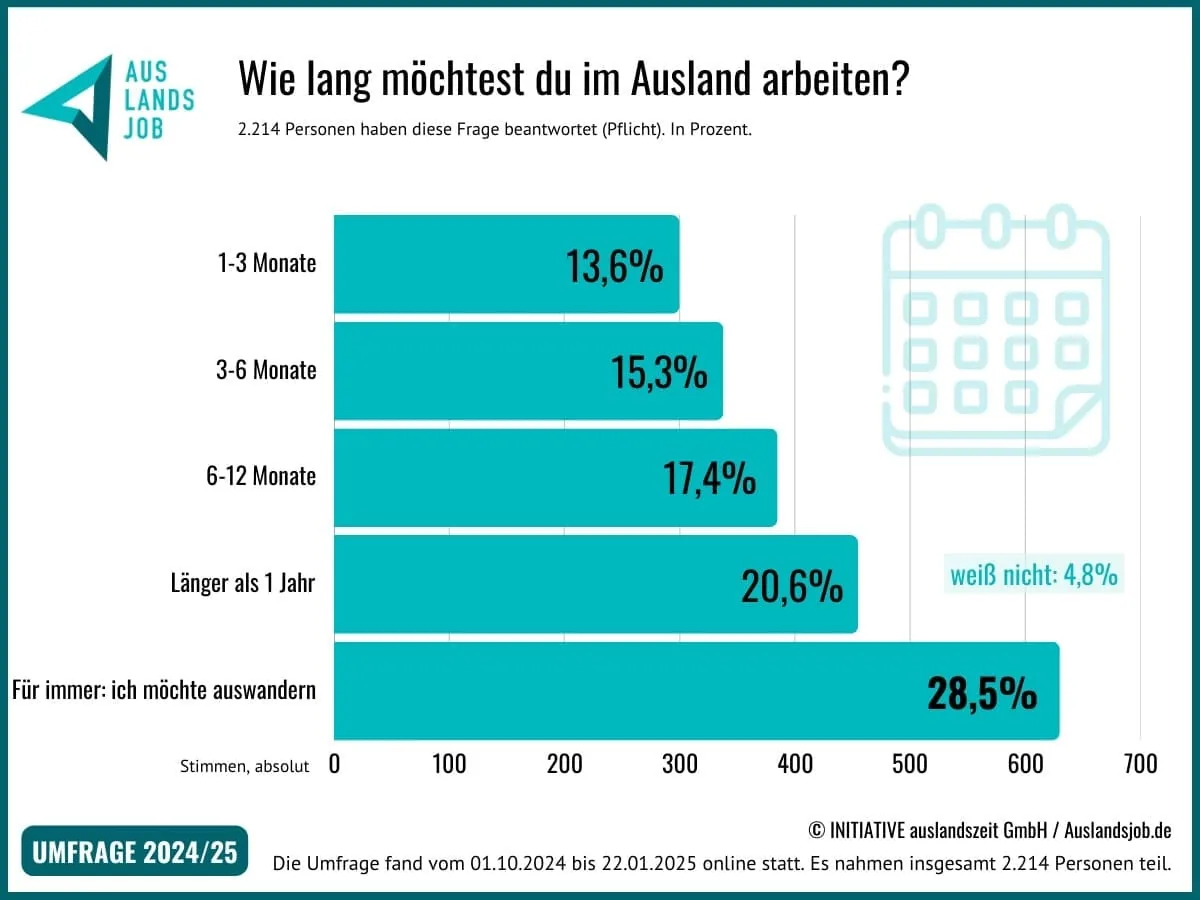
The survey of 2,214 participants shows that around half plan to work abroad for more than a year or permanently. The topic is therefore much more than just a „might as well give it a try.“.
Helpful questions to start:
Should it be a temporary change of scenery or a real fresh start?
How do income, career, and security compare to climate and quality of life?
How close should the connection to one's homeland remain?
Another important decision is whether to prioritize „job first or country first.“ According to the study, about one-third focus on the destination country, while another third focus on the job or the nature of the work. Both approaches work, but problems arise especially when you don’t set a clear priority at all.
Job Search Abroad: Ways to Find the Right Job
2.1 Work Models in Other European Countries
When it comes to how people would like to work abroad, the study shows a close race. About one-third prefer in-person jobs, another third prefer hybrid models, and significantly fewer opt exclusively for remote work or a life as a digital nomad.
For the planning, this means:
Whoever is ready for in-person work has the largest selection of jobs abroad.
Hybrid models are becoming particularly attractive to international employers in major European cities.
Working entirely remotely works best in digital professions that offer a high degree of location flexibility.
2.2 Channels for Jobs in Other European Countries
Anyone seriously interested in working abroad should use multiple channels at the same time:
Specialized job portals for jobs abroad
European and national job boards in the target countries
Professional networking sites such as LinkedIn
Personal connections, alumni networks, and industry events
Recruitment agencies, for example, for jobs in the hotel, restaurant, or international service industries
In the survey, many respondents primarily desire support with their job search and applications, as well as a central portal with matching offers. This demonstrates how great the need for guidance regarding jobs abroad is.
Study on Motivations for Working Abroad and Europe
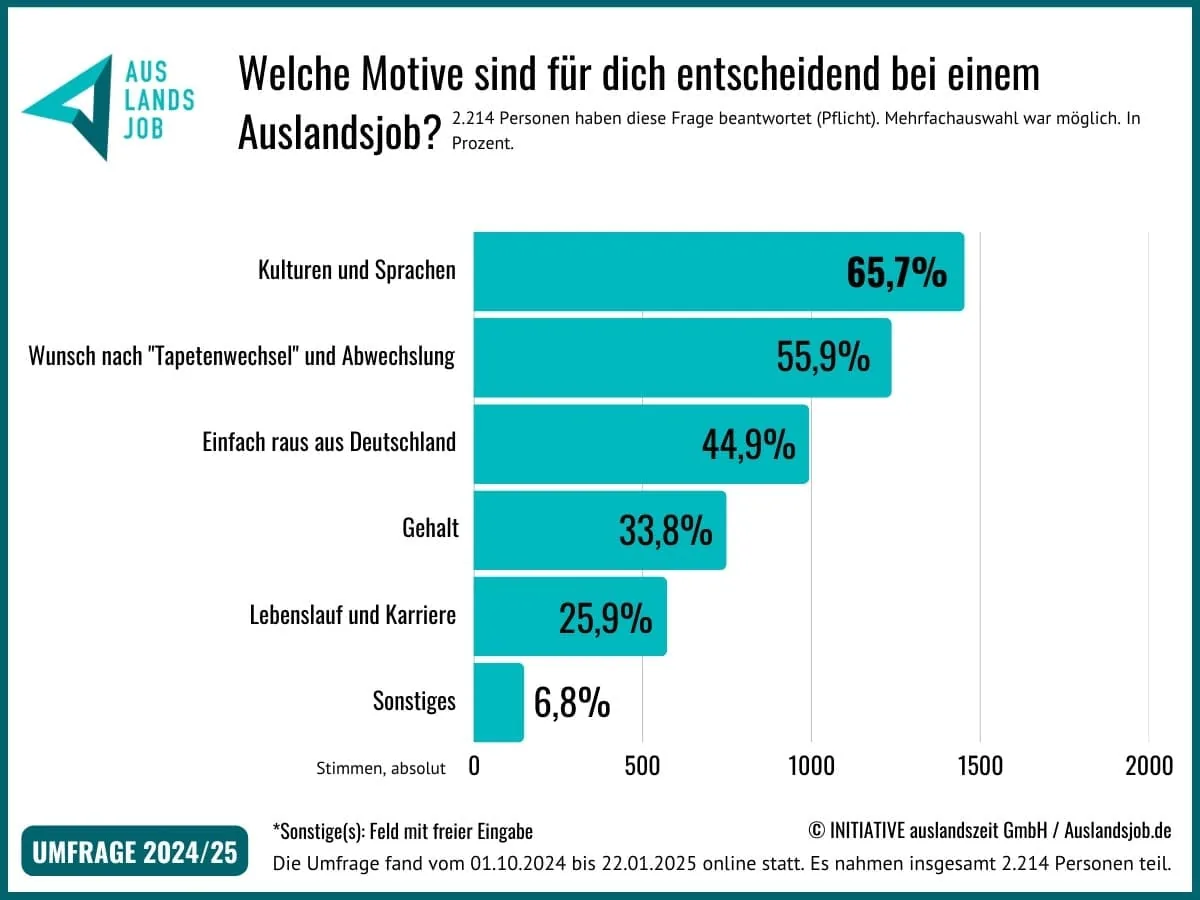
The 2024/25 Overseas Job Survey makes it clear why Working Abroad is barely noticeable.
Key themes:
experience other cultures and languages
A Change of Scenery and More Variety
the desire to leave Germany
Europe offers many options in this regard, with a variety of languages and lifestyles, while still being a manageable distance from home.
Among the top destinations, Spain is clearly in the lead, followed by Italy, Portugal, Switzerland, and Greece. What they all have in common is a combination of a pleasant climate, quality of life, and a relatively well-developed infrastructure. When planning your own move abroad, it’s worth taking a look at the best countries to emigrate to, to sort your personal shortlist based on the pros and cons of each destination.
The plans are also concrete when it comes to the timeline. Many want to get started within the next twelve months; a large number are aiming for a longer-term or permanent stay; and a high percentage are already actively looking for jobs.
„"Today, the younger generation is planning their jobs abroad much more strategically than they did just a few years ago. It's no longer just about 'work and travel,' but about real career prospects abroad, often with a long-term plan to live in Europe."“ Frank Möller, Managing Director of Auslandsjob.de
Arriving in Your Destination Country: Work and Life Abroad
The actual emigration process begins when you arrive in your destination country and everyday life gets underway. This is exactly when you’ll find out whether your job abroad fits the life you want to lead there.
According to the study, housing and settling in are the biggest hurdles, closely followed by red tape and a lack of language skills.
It follows that:
You shouldn't book a flight without rough budget planning.
Temporary housing for the first few weeks takes some of the pressure off the search for a place to live.
It’s a good idea to clearly specify in the employment contract whether the employer will provide support during the onboarding process, for example through relocation benefits.
Work culture also plays a major role. Feedback, hierarchies, and communication work differently in European countries. Those who actively ask for feedback in the first few weeks, build relationships within the team, and seek contacts with the expat community and locals will settle into their new everyday work life much faster.
Checklist: 7 steps to a job abroad in Europe
A short checklist helps to approach the emigration project in a structured way:
Clarify goals Why would someone want to go abroad, for how long, with what financial minimum, and with what career prospects?
Define destination country and working model Choose a European destination country and decide whether the focus is on on-site, hybrid, or remote work. Without this clarity, the job search remains arbitrary.
Check the framework conditions Check residence rights, registration requirements, taxes, social security, and health insurance in the destination country.
Structuring the job search abroad Define target industry and salary band, select suitable portals and networks, set a weekly application goal.
Optimize application documents Adapt CV, cover letter, and online profiles to international standards and the target country. State language skills realistically, yet confidently.
Review contract Record working hours, compensation, probation period, vacation policy, remote work share, and potential relocation benefits in writing.
Plan arrival Organize temporary accommodation, research initial administrative procedures, start a language course, build a local network.
FAQ: Working and Living Abroad in Europe
Below is an overview of frequently asked and important questions regarding the topic of emigrating within Europe and job hunting.
Many are planning their move abroad within a year and are thinking long-term rather than just in months.
Above all, new cultures and languages, the desire for a change of scenery, and a clear break from my previous daily routine.
Accommodation and arrival, bureaucracy, language, and the search for a suitable job and salary.
Nail down the goals and framework conditions. Without a clear "why," "how long," and "with what budget," everything remains vague.
Because legal hurdles and distances are usually lower, alongside a great variety of countries and lifestyles.
Conclusion
Working abroad is not a spontaneous whim for many, but a well-thought-out step for career and lifestyle. The 2024/25 working abroad survey shows how concrete the plans are and how strongly Europe stands out as a destination region.
Share
Clemens KohlbacherFounder & Managing Director, Global Setup
For over ten years, Clemens has been advising entrepreneurs, investors and families on international company formation, tax strategy and relocation of residency. His focus: legal, bank-compliant structures that hold up in practice, not just on paper.
In recent years, Germany and other EU countries have become increasingly unappealing to high achievers due to political uncertainty, high taxes, and economic problems. Consequently, a growing number of people are emigrat
Malta is a popular tax haven in Europe and is attracting not only tourists, but also a growing number of expats. In addition to the fine weather, attractive tax benefits also draw many entrepreneurs and investors to Malt
In times of economic and political uncertainty, as well as high taxes and the introduction of the Asset registers in the EU , more and more people from Germany are moving abroad.
July 2, 2026·7 min read
Not sure where to start?
Schedule a 30-minute conversation with a senior consultant. We answer your questions and work out the best path to your goals.


 Clemens Kohlbacher