The EU-wide asset register, scheduled to be introduced starting in 2025, is a significant new instrument of the European Union to combat money laundering, terrorist financing, and tax evasion. This register is part of a broader package of measures aimed at increasing asset transparency and fighting illicit financial flows within the EU.
Goals of the EU-wide asset register
Increasing transparency:
The asset register is intended to help make the ownership and control of assets such as real estate, bank accounts, corporate holdings, and other significant assets more transparent.
It will facilitate the identification of beneficial owners, meaning the individuals who actually stand behind an asset, even if it is formally obscured by complex corporate structures or trust arrangements.
Combating financial crime:
The register is a tool for preventing and detecting money laundering and terrorist financing. By centrally recording and linking asset data, it becomes more difficult for criminals to hide illegal funds.
Support of the tax authorities:
It is intended to help tax authorities in EU member states uncover tax evasion and ensure that all citizens and businesses pay their taxes correctly.
Essential content and functionality
Central database:
The asset register will function as a central database within the EU, in which information on various types of assets is recorded.
This includes bank accounts, real estate, business interests, luxury goods such as expensive vehicles, works of art, and other valuable assets.
Linking of national registers:
There will be a linking of existing national registers and databases to enable a comprehensive overview of the financial assets of individuals and companies in the EU.
This affects, among other things, land registries, business registers, and bank account registers in the individual member states.
Access rights:
Authorized authorities in the EU member states, such as tax authorities, financial supervisory authorities, and law enforcement agencies, are granted access to the register.
Access to the data is strictly regulated to ensure data protection and to ensure that the information is used only for lawful purposes.
Reporting obligation:
Banks, real estate agents, notaries, and other professional groups involved in the management or transfer of assets will be required to report information to the asset register.
Companies and individuals must ensure that their financial assets are correctly and completely recorded in the register.
Concrete limits and clues
In the current version, the following points are particularly interesting and/or relevant in practice for most people.
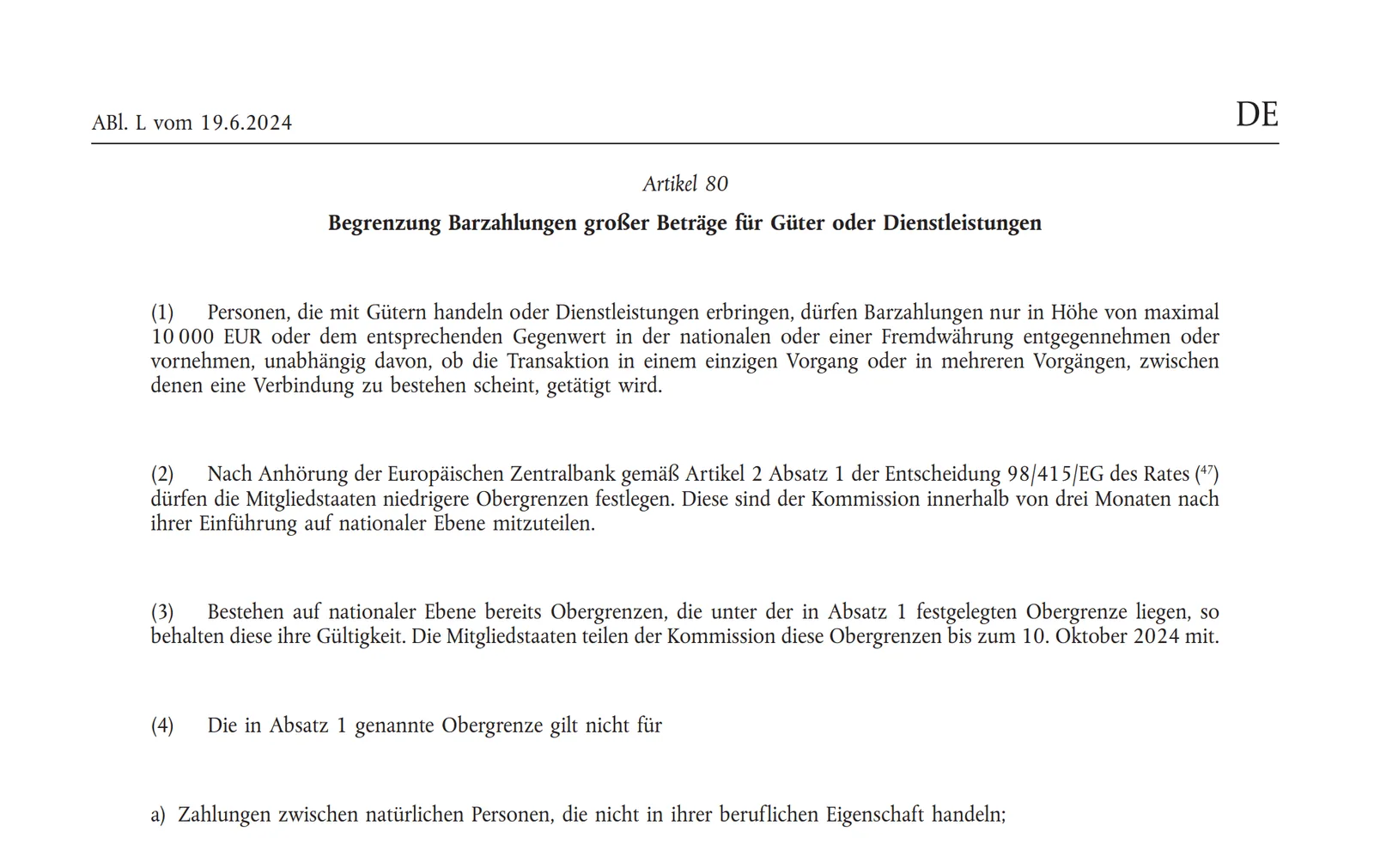
Ban on cash for all transactions of €10,000 or more (except between two private individuals)
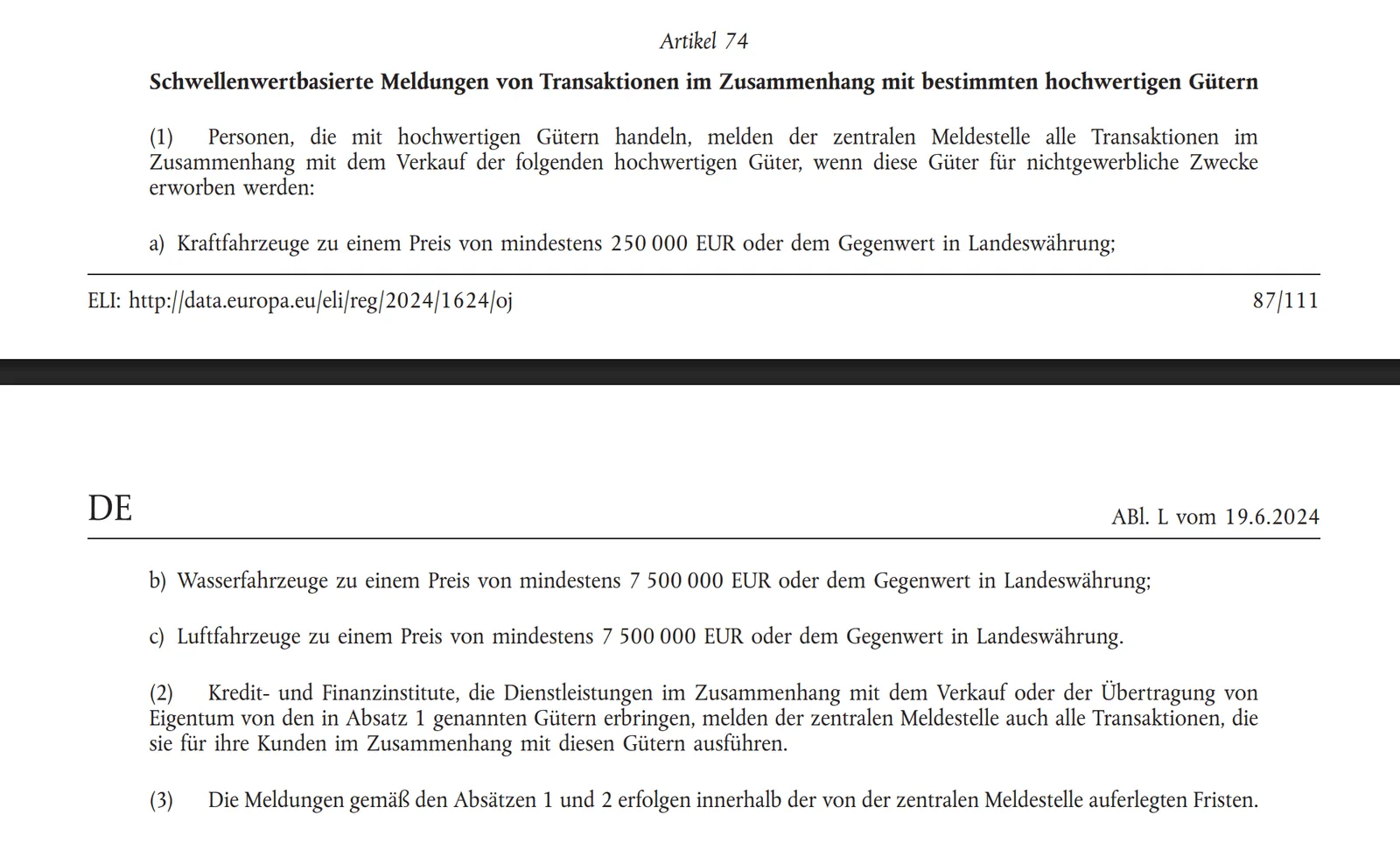
Recording of all transactions starting from €250,000 for cars
Recording of all transactions starting from €7,500,000 for aircraft and watercraft
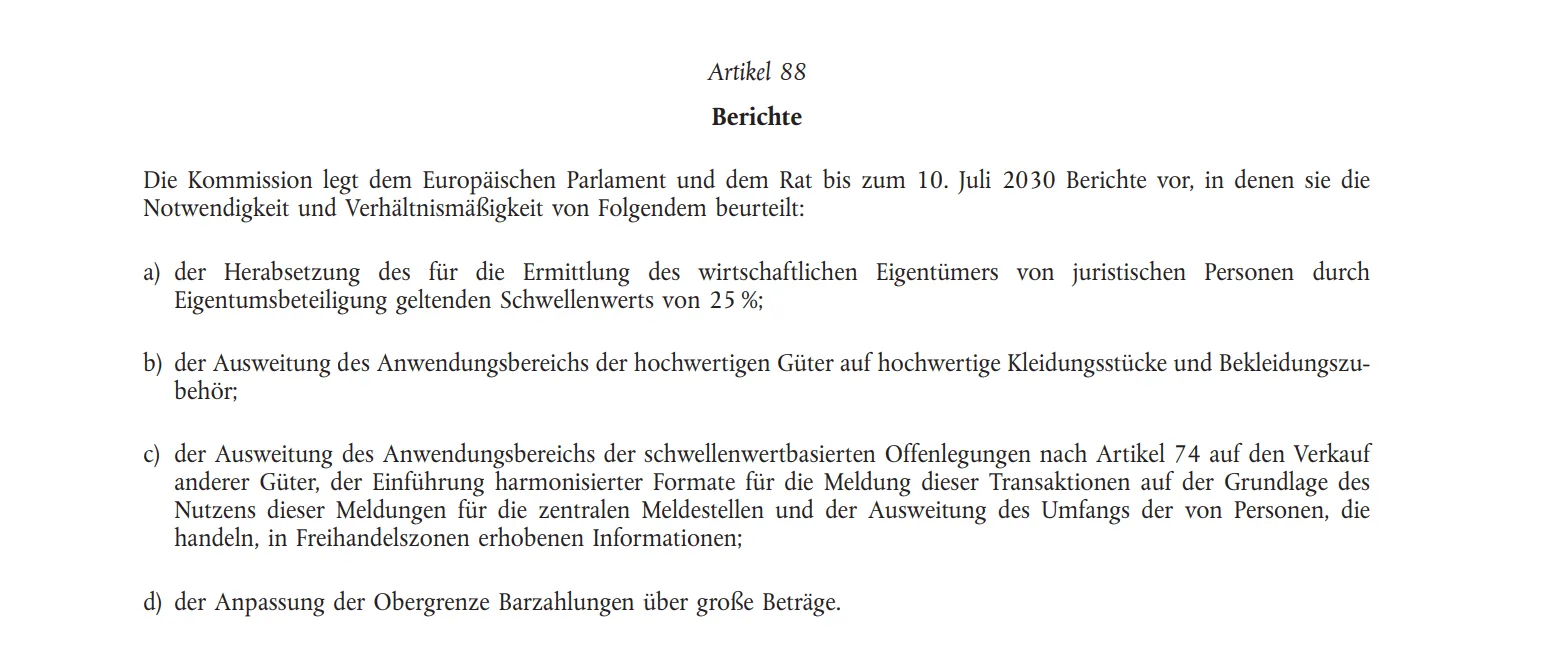
A potential expansion of the mandatory reporting to clothing and other luxury goods is currently still being examined.
Relevance and Impact
For individuals: EU citizens must prepare for their financial situations to become more transparent in the future. This already applies to individuals with assets or luxury goods starting at €10,000.
For businesses: Companies must disclose their ownership and financial structures, especially if they operate across borders. This could mean additional administrative effort and increased monitoring by authorities.
For EU member states: The register will enable Member States to act more effectively against tax evasion and money laundering. It will also strengthen cooperation between national authorities.
Entry into force
The law in this version has already been passed, but will only fully enter into force in 2027 or, for football clubs, as of 2029. However, the law applies in combination with other laws, such as the Asset Concealment Combating Act.
Criticism and challenges
Privacy Policy: There are concerns regarding the protection of personal data and how access to the information in the register will be regulated to prevent abuse.
Implementation: The introduction of such a register requires extensive coordination between EU member states and the creation of new technical and legal structures, which presents a challenge.
Preparation for expropriation: Steps of this kind always pave the way for direct (e.g. Load balancing) or indirect expropriation. Because assets must first be recorded before they can be confiscated or nationalized.
Ways out
To escape the asset register, one simply has to try to move their residence and assets out of the EU, because the law only applies at the EU level.
Change residence
If one still has illiquid assets such as real estate, businesses, or similar, one should definitely change their residence at the beginning, as this is the main starting point for capturing the wealth one holds privately.
However, one must definitely pay attention to the exit tax, which, for example, in Germany or applies to Austria. Here, too, however, there are ways to structure things to avoid it.
It is impossible to say generally which countries within the EU are best suited for emigration, but here is an overview of the most popular emigration destinations outside the EU with links to further articles:
An interim solution is to relocate certain assets abroad, or to transfer them to people who live abroad and are not affected by this rule. Another possibility can also be the Establishing a foundation in Liechtenstein or on the Cook Islands.
Summary
The EU-wide asset register starting in 2025 is an ambitious project aimed at significantly increasing the transparency of assets within the European Union. It will be a central instrument for combating money laundering, terrorist financing, and tax evasion by creating a comprehensive database of asset information that authorized authorities can access. At the same time, it brings challenges, particularly in the areas of data protection and implementation, which must be addressed prior to its introduction.
Share
Clemens KohlbacherFounder & Managing Director, Global Setup
For over ten years, Clemens has been advising entrepreneurs, investors and families on international company formation, tax strategy and relocation of residency. His focus: legal, bank-compliant structures that hold up in practice, not just on paper.
In recent years, Germany and other EU countries have become increasingly unappealing to high achievers due to political uncertainty, high taxes, and economic problems. Consequently, a growing number of people are emigrat
Malta is a popular tax haven in Europe and is attracting not only tourists, but also a growing number of expats. In addition to the fine weather, attractive tax benefits also draw many entrepreneurs and investors to Malt
In times of economic and political uncertainty, as well as high taxes and the introduction of the Asset registers in the EU , more and more people from Germany are moving abroad.
July 2, 2026·7 min read
Not sure where to start?
Schedule a 30-minute conversation with a senior consultant. We answer your questions and work out the best path to your goals.


 Clemens Kohlbacher