The establishment of a foundation in Liechtenstein has been a popular tool for wealthy individuals for many years to protect assets and save potential taxes. But what is a Liechtenstein foundation, how does it work, and what is the process (including costs) for establishing one?
All these questions are answered in this comprehensive guide on the Liechtenstein Foundation.
What is a foundation in Liechtenstein?
First of all, one should definitely understand the term Liechtenstein Foundation in order to weigh up whether establishing one is even an option. A foundation is fundamentally a separate legal entity, similar to a limited liability company (LLC). However, with the crucial difference that the foundation does not have an owner in the form of a natural person.
This means that a foundation is completely detached from the founder itself, or rather, the assets are contributed and assigned to the foundation by the founder. The assets are now in the possession of the foundation.
In addition, a distinction must be made between charitable and private-benefit foundations. Most foundations fall into the second category of private benefit.
Structure
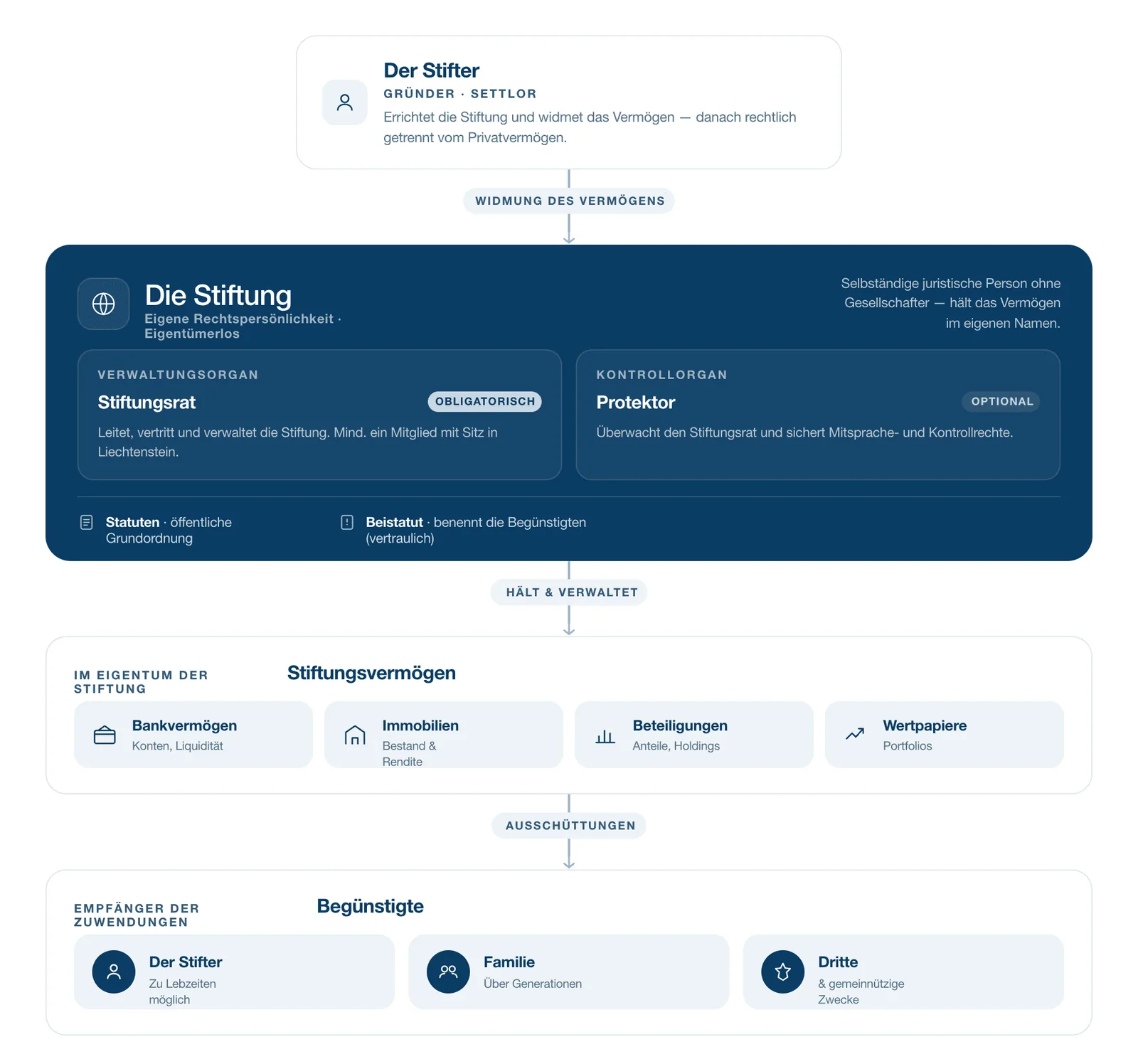
A foundation is structured quite differently from common legal entities such as a GmbH and is a unique legal person. As mentioned at the beginning, a foundation itself does not have an owner, but it has the following bodies that are necessary and ensure the ongoing preservation of the foundation.
Founder At the very top is, of course, the founder himself, who initiates the establishment of the foundation in Liechtenstein and also contributes the assets.
Foundation Board One or more persons sit on the foundation board (one of them domiciled in Liechtenstein – usually a lawyer acting as a trustee). They manage the foundation and make everyday decisions based on the articles of association.
Protector Optionally, another supervisory body, the protector, can also be appointed to oversee the Foundation Board and its decisions.
Beneficiaries Among the beneficiaries are all people, companies, or institutions that are allowed to financially benefit from the foundation and receive distributions. These are usually family members or the founder themselves.
Location
Liechtenstein is, as the name already indicates, the location of the foundation. The jurisdiction is ideally suited as a location for a foundation for several reasons. Foundation law in Liechtenstein is now around 100 years old and essentially still exists in its original form.
In addition, the foundation law is 100% compliant with EEA and EU law, making it particularly suitable for assets located within the EU.
Liechtenstein itself is a neutral and very secure country, both from a geographical and political perspective. Basically, it is neither a member of NATO nor the EU and is therefore largely neutral politically.
Anyone who chooses Liechtenstein as a location for their foundation can look back on a decades-long history characterized by stability.
Advantages
Establishing a foundation in Liechtenstein offers several advantages for entrepreneurs, investors, and wealthy individuals from all over the world. Germans and Austrians, in particular, can benefit from a foundation in neighboring Liechtenstein. Below is an overview of the most important advantages.
Asset protection
One of the most important advantages of a Liechtenstein foundation is asset protection, usually also intended to have a cross-generational impact. Because as a private individual, unpredictable things can always happen, and liability can fall back on key persons even in the case of LLCs and similar legal entities. By transferring the assets to the foundation, they are generally largely protected, and claims against the founder (the creator of the foundation) cannot usually be enforced against the foundation itself.
Only in rare cases, for example when it involves targeted asset concealment or obfuscation in ongoing criminal proceedings or similar, can a foundation potentially be challenged.
A foundation is particularly useful, especially for family businesses or wealthy families in general, whose assets are intended to provide security for multiple generations.
Taxes
Another important factor that motivates the establishment of a foundation is the issue of taxes. High-tax countries like Germany, Austria, and European jurisdictions are naturally a major factor when it comes to wealth.
Inheritance & Gift
Especially inheritance, gift, and wealth taxes can become extremely unpleasant from a financial perspective.
For example, in 2025 the family of the entrepreneur Hein Hermann Thiele had to transfer over 4 billion euros in inheritance tax to the Kaufbeuren tax office because restructuring was done too late and no foundation held the assets or company shares.
Even in a direct comparison with the German foundation, this results in a clear advantage, because there is also no inheritance substitute tax, which would be due for foundations in Germany every 30 years.
Capital gains
Aside from inheritance tax, the tax burden on operating profits is, of course, significantly lower than that of a GmbH in Germany, Austria, or Switzerland. This is because the corporate income tax rate in Liechtenstein is only 12.5 %. In addition, there are further tax benefits on rental income from Germany and low taxes on dividends distributed to the foundation.
Another interesting aspect to add is that Liechtenstein foundations generally do not pay corporate income tax on capital gains from abroad. Since most public companies are located abroad (for example, Google, Nvidia, and the like), capital gains on these shares are also tax-exempt. The only exceptions here are interest from bank accounts.
Beneficiaries
However, beneficiaries who receive payments from the foundations always pay the applicable rate of capital gains tax—or “withholding tax,” as it is known in Germany. Thus, the beneficiary’s place of residence is decisive when it comes to distributions from the foundation. In the best-case scenario—such as in Monaco or Dubai—the tax rate is 0 %.
A foundation in Liechtenstein can therefore potentially be tax-exempt. Only the minimum corporate income tax of 1,800 CHF must be paid if applicable.
Anonymity
Another advantage is the anonymity that foundations in Liechtenstein provide. Because although there are disclosure obligations toward tax authorities, private individuals cannot access information about foundations and their founders or beneficiaries.
For whom is a Liechtenstein foundation suitable?
One of the most important questions is, of course, for whom a foundation in Liechtenstein is actually suitable. This question should always be clarified individually by a technical expert. However, the general rule of thumb is that a foundation should only be considered when the assets to be contributed exceed 1 million EUR. This is because a foundation also costs money (more on that later) and therefore should generate a certain return to sustain itself.
Otherwise, it obviously makes sense for anyone who wants to protect and preserve assets effectively (across generations).
Procedure
The procedure for establishing a foundation is clearly regulated and requires the following steps to set up a foundation.
Consulting
The first step is to gather reliable information and consult with a specialist. Because whether and in what form a foundation makes sense should always be clarified in detail in advance before proceeding with implementation. After all, transferring parts of one's assets to a foundation is a major step. This should be carefully planned and considered.
Choose law firm / fiduciary
Subsequently, the appropriate local law firm should be chosen. Ideally, these are local lawyers who specialize primarily in the field of foundation law and at the same time offer trusteeship within the foundation board or have a partner for this purpose.
The task of the law firm is the clean structuring and establishment of the foundation as well as the ongoing review of legal certainty for the project.
The trust or trustee sits on the foundation board and manages the day-to-day business of the foundation.
Declaration of Foundation
The foundation is brought to life by the foundation declaration. It is the founding document and contains, among other things, the statutes.
The statutes are the heart of the foundation and regulate the structure, purpose, and use of the foundation. They define the founder, trustees, protectors, and foundation board members, as well as beneficiaries. The declaration also sets out how the foundation is to act concretely and what goals it pursues.
Provide capital
Next is the provision of capital. This is typically 30,000 francs, but can also be contributed in Euros or US dollars.
appoint a foundation board member
Next, the Foundation Council is appointed. This represents the foundation externally and regulates the ongoing business of the foundation and the fulfillment of its purpose. One member of the Foundation Council must be resident in Liechtenstein. This is usually a lawyer admitted to practice in Liechtenstein.
Optionally, a protector can also be ordered to continuously monitor the foundation.
Commercial register entry
Subsequently, the documents are submitted to the authority and the entry is made in the commercial register.
Account opening
Following successful establishment and registration, the account is opened, usually with a local bank in Liechtenstein such as the LLB. The bank handles the payment flows and also carries out checks regarding the origin of funds and money laundering.
Ongoing: Accounting & Annual Financial Statements
Continuous bookkeeping, as well as the preparation and setup of the annual financial statements, is also necessary. For this purpose, local tax accounting firms are usually hired.
FAQ
Below is an overview of the frequently asked questions regarding the establishment of a foundation in Liechtenstein.
The difference between a foundation located in Germany and one in Liechtenstein is relatively large. Foundation law in Germany is structured somewhat differently. Significant differences lie in the separation between public benefit and private use.
In addition, foundations in Liechtenstein are more attractive from a tax perspective, since, as mentioned, the corporate income tax rate is only 12.5 %, which is about half that of Germany.
Furthermore, there is no inheritance tax in Liechtenstein, but there is indeed a substitute inheritance tax that is levied every 30 years on foundations in Germany.
In addition, the banking environment in Liechtenstein is more interesting than that in Germany, as it is primarily designed for wealthy clients.
Establishing a foundation usually takes no longer than a few weeks. Most of the time is invested in consulting and structuring, as this forms the foundation for a sustainably successful foundation.
This is an essential question that every founder must ask themselves. Basically, there are two options: donation or sale. Depending on the founder's place of residence, taxes apply here, and the approach must always be weighed on a case-by-case basis. Apart from the location, the asset class is of course also a decisive factor, because real estate and company shares are potentially taxed differently in the event of a gift.
Costs
The costs for a Liechtenstein foundation can generally be divided into two areas: 1. Establishment and 2. Maintenance or ongoing annual costs. Both depend heavily on the complexity and structure of the foundation.
Setup fee (one-time)
The costs for establishing a Liechtenstein foundation average around €20,000 – €40,000 and are composed of the following services.
Consulting
Foundation deed including statutes
Appointment to the Foundation Board
commercial register entry
Application for tax number
Additionally, a share capital of €30,000 (USD or CHF are also possible) must be contributed. However, this is transferred to the foundation's assets.
Annually
The annual costs for a incorporation average around €10,000 – €20,000. Here too, the variance lies in the complexity of the structure and the scope of the trustee's activity. Basically, however, the following services are to be remunerated:
Tax advisor for bookkeeping and annual financial statements: 3,000 – 4,000 CHF
Minimum corporate income tax: CHF 1,800
Escrow: 10,000 CHF
Risks
However, a foundation is not completely risk-free if it is not properly applied or structured. Below are the most common risks and mistakes that occur in the area of foundation establishment in Liechtenstein.
Tax transparency
Anyone who structures foundations in such a way that the founder continues to retain complete, direct control over the foundation's daily decisions and also makes them actively runs the risk of compromising the foundation's transparency. Specifically, this means that from a tax perspective, a foundation is only separated from the founder themselves when the latter no longer has direct control over it. A foundation must be largely detached in order to be independent for tax purposes.
Concealment or Obstruction of Assets
Anyone already involved in an investigation or criminal proceeding involving high creditor claims should refrain from establishing a foundation and transferring assets. This is because delaying or concealing assets that would be due to creditors would have further criminal consequences.
Therefore, it is always advisable to establish a foundation in a timely and proactive manner before claims by creditors arise. After all, as an entrepreneur, investor, or public figure, one quickly becomes a target for others.
Summary
The establishment of a foundation in Liechtenstein can be an effective means of protecting and preserving wealth across generations, as well as saving taxes. By transferring assets to a foundation, they are protected in a secure low-tax country with around 100 years of successful history.
In practice, setting up a foundation only pays off from a financial perspective when assets exceed 1 million euros, as the costs for establishment and ongoing maintenance are in the five-figure range.
Share
Clemens KohlbacherFounder & Managing Director, Global Setup
For over ten years, Clemens has been advising entrepreneurs, investors and families on international company formation, tax strategy and relocation of residency. His focus: legal, bank-compliant structures that hold up in practice, not just on paper.
In recent years, Germany and other EU countries have become increasingly unappealing to high achievers due to political uncertainty, high taxes, and economic problems. Consequently, a growing number of people are emigrat
Malta is a popular tax haven in Europe and is attracting not only tourists, but also a growing number of expats. In addition to the fine weather, attractive tax benefits also draw many entrepreneurs and investors to Malt
Paraguay has become increasingly popular in recent years, and more and more people, especially from Central European countries, are emigrating to Paraguay. One reason for this is the low taxes and the attractive tax syst
July 4, 2026·12 min read
Not sure where to start?
Schedule a 30-minute conversation with a senior consultant. We answer your questions and work out the best path to your goals.


 Clemens Kohlbacher