In recent years, Germany and other EU countries have become increasingly unappealing to high achievers due to political uncertainty, high taxes, and economic problems. Consequently, a growing number of people are emigrating from Germany.
However, the deregistration must be carried out in compliance with the law, which is why all the necessary steps, including a checklist, are listed here.
Step-by-step guide: De-registering from Germany
Dereistering from Germany is necessary when moving your primary residence abroad or permanently leaving Germany. Here is a detailed step-by-step guide including a checklist:
1. Plan deregistration & departure
The first step is to plan the departure and deregistration, because there are legal deadlines that must be met. In fact, from a tax perspective, a deregistration only becomes legally effective when, apart from the deregistration, the residence in Germany has actually been given up and verifiable departure has taken place.
This means that in addition to the formal deregistration with the registration office (more on that in a moment), it is important to give up the residence and the power of disposal over the keys (especially when moving abroad to countries with which there is no DTA, e.g., Dubai)
Note: You are only required to deregister if you are moving abroad permanently or no longer have a residence in Germany. Temporary or short-term stays abroad for work, study, or travel do not require deregistration.
Deadlines: According to [...], the cancellation Section 17 BMG must take place no earlier than 7 days before and no later than 14 days after departure.
2. Prepare documents
In addition to scheduling, you should also prepare all crucial documents for deregistering from Germany. Below is an overview of documents that are particularly important for the deregistration:
Identity card or passport (original and copy if applicable).
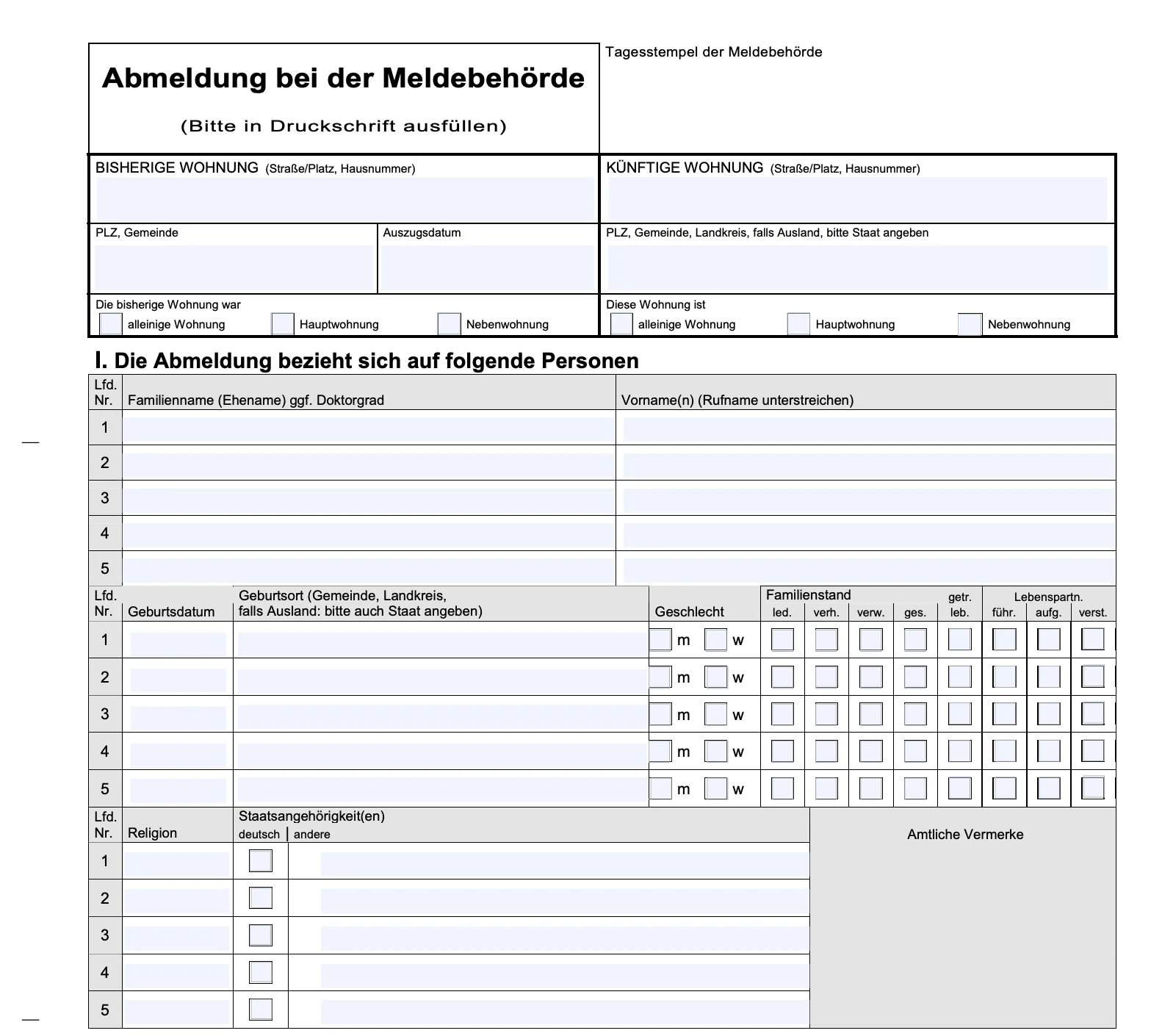
Deregistration form (available at the citizens' office or online on the city administration's website).
Proof of the new address abroad, if available (e.g., rental agreement or certificate).
If applicable: Power of attorney, if someone else is handling the deregistration for you.
3. Fill out the cancellation form
The deregistration form is usually provided by your registration office. Either as a printed paper form or nowadays digitally. The following information is filled out:
Name and current address in Germany.
New address abroad (optional, if known).
Date of moving out.
Reason for deregistration: Example: „Moving abroad“.
It is important not to forget the signature.
4. Deregistration with the competent registration authority
Appointment at the local registration office (Citizens' Registration Office or Town Hall). Bring all prepared documents. It is best to simply search via Google in the city or municipality for the registration office that is closest and accordingly responsible.
Optional: Some registration offices allow you to deregister online or by mail.
5. Received confirmation of unsubscription
After logging out, you receive a Certificate of deregistration. Among other things, this certificate is important for:
Tax matters (e.g., deregistration with the tax office)
Cancellation of insurance policies, broadcasting fee (GEZ), etc.
Account openings or registrations abroad
6. Informing authorities and service providers
Apart from the registration office, one should of course inform all other official authorities about the relocation and emigration. Below are the most important institutions and authorities that should be notified.
Tax office Tax matters and potential tax deregistrations.
Health insurance fund To clarify the insurance coverage or to cancel.
Insurances: Liability, renters, life insurance, etc.
Employer: Notice of termination or notification of moving.
GEZ (broadcasting fee): Cancellation is possible directly online on their website.
Banks: Provide a new correspondence address or close accounts if necessary.
Phone/Internet provider: Cancel or transfer contracts.
Post: Apply for mail forwarding with Deutsche Post.
Otherwise, other private institutions should also be informed, especially when it comes to membership fees or other binding payments.
Clubs or Memberships (e.g., gym, clubs).
Preschool or schools (if children are affected).
Chamber of Crafts or Chamber of Commerce and Industry (for self-employed individuals).
Apartment Handover and Lease Agreement
As mentioned at the beginning, one of the most important points is the effective relinquishment of one’s residence and control over one’s assets. This is particularly crucial from a tax perspective when emigrating to countries that do not have a tax treaty with Germany.
Giving Notice on an Apartment: Be sure to observe the notice period specified in the lease agreement (usually 3 months).
Apartment Handover: Handover Report for Apartment Handover
Checklist
Here is a brief checklist summarizing the most important steps for deregistering from Germany.
✅ Have your ID card or passport ready. ✅ Fill out the cancellation form completely. ✅ Schedule an appointment with the registration office (or complete the deregistration process online or by mail). ✅ Receive your certificate of deregistration and keep it in a safe place. ✅ Notify the tax office and resolve tax matters. ✅ Cancel or transfer insurance policies. ✅ Notify employers, banks, and the GEZ. ✅ Cancel contracts (internet, phone, memberships). ✅ Set up a mail forwarding request with Deutsche Post. ✅ Conduct the apartment handover and prepare a handover report.
Deregistering from Germany Without a New Place of Residence
If you want to deregister from Germany and no new residence abroad Whether you can or want to specify this, there are a few differences and specific rules to keep in mind. Here are the details:
The process for deregistration remains largely the same, but there are a few special considerations:
No proof of a new address is required
Normally, when deregistering, the authorities require you to provide a new place of residence (e.g., an address abroad). If you do not have a new place of residence, you should instead indicate that you have „no new residential address“ or that you are temporarily homeless.
In the deregistration form, under „new address,“ you enter:
„"without a permanent residence"“ or
„"unknown"“ (if you don't yet know where you'll be staying).
Specific wording in the cancellation form
In the „Reason for unsubscription“ field, you should state the reason for your unsubscription as precisely as possible:
„Clearing out a home without a permanent residence“ or „Foreign trip with unknown destination“.
Alternatively, you can explain informally why no new place of residence is being provided, e.g.:
Long-term travel.
Indefinite stay (e.g., world trip, digital nomads, etc.).
Penalties
If unsubscription is not carried out on time, numerous penalties and fines can be imposed. Below is an overview of the biggest mistakes and penalties that can occur during unsubscription.
Below is an overview of practical tips regarding departure and deregistration from Germany for an extended period.
Take the tax return into account
Anyone who deregisters from Germany and emigrates is subject to unlimited tax liability in Germany until the date of departure, but must file a tax return for the entire year. Accordingly, many plan to emigrate toward the end of the year, since they have lived in Germany for the entire year anyway and are subject to unlimited tax liability.
Anyone who emigrates in April must file a tax return at the end of the year that takes into account full tax liability through April and includes limited tax liability for the remainder of the year (e.g., taxes on rental income or investment income such as interest from Germany).
Clarify Exit Taxation
It is essential to clarify whether, upon deregistration and moving abroad, the Exit taxation arises. This generally affects all entrepreneurs or individuals with shares in capital companies such as GmbHs. The value growth from acquisition up to the time of emigration is taxed here. A fictitious sale occurs, so to speak.
Furthermore, for entrepreneurs, a relocation of functions or cross-border conversion (tax detachment of assets) can also occur if the business is re-established abroad and certain shares or the entire company are transferred abroad. This should definitely be clarified with a local tax advisor.
This excludes free float, i.e., shares held by less than 1 %. However, mutual funds and ETFs with individual positions exceeding €500,000 have been subject to the exit tax since 2026.
Renew passport
Anyone planning to stay abroad for a longer period of time should definitely renew their passport. This saves a lot of headaches, as many countries require a passport that is valid for at least another 6 to 12 months. Renewal abroad is possible, but takes longer and usually costs more.
Frequently Asked Questions
Below is an overview of the most frequently asked questions regarding deregistration from Germany.
The Online cancellation is generally possible as long as your city or municipality supports this service. Information on available options can be found on the website of the competent registration authority. If a complete online deregistration is not offered, deregistration by mail or email remains an alternative.
No, but it is definitely recommended to take out international health and accident insurance.
Yes, it is possible to deregister from Germany while living abroad, if you have already left the country. This can be done via Post, Email or even partially online take place, depending on the services of your responsible registration office.
No, as described above, it is not mandatory to provide a new place of residence. Often this is not even possible due to traveling the world or in the Perpetual Traveler model as Digital nomad.
No, deregistration or residency has nothing to do with citizenship. This is usually kept for a lifetime.
No, in the case of a temporary stay abroad (e.g., a semester abroad), deregistration is not necessary. You only need to deregister when the stay is or becomes permanent.
No, there is no globally uniform reporting obligation. Anyone who deregisters and no longer settles in any country in the world is de facto a perpetual traveler or digital nomad. There is no obligation to register in a new place, as many countries do not even have a registration law.
Summary
De-registration from Germany is necessary when moving abroad or giving up your residence. This requires your identity card or passport and the de-registration form, which is available online or in person. If no new address is available, „of no fixed abode“ or „unknown“ can be stated. De-registration can be done either in person at the citizens' registration office, online, by post, or by email, depending on the services offered by your registration authority. Many cities now make it possible to de-register online, often using the online ID function or a user account. After de-registration, you receive a de-registration certificate, which is important for tax matters or for canceling contracts. In addition, the tax office, insurance companies, the broadcasting fee service (GEZ), employers, and other service providers should be informed, and contracts and the handover of the apartment should be arranged. With good preparation, the process can be carried out smoothly.
Share
Clemens KohlbacherFounder & Managing Director, Global Setup
For over ten years, Clemens has been advising entrepreneurs, investors and families on international company formation, tax strategy and relocation of residency. His focus: legal, bank-compliant structures that hold up in practice, not just on paper.
Malta is a popular tax haven in Europe and is attracting not only tourists, but also a growing number of expats. In addition to the fine weather, attractive tax benefits also draw many entrepreneurs and investors to Malt
In times of economic and political uncertainty, as well as high taxes and the introduction of the Asset registers in the EU , more and more people from Germany are moving abroad.
Escape everyday life, slow down, and benefit from tax advantages at the same time—more and more people are drawn to Cyprus. The Mediterranean island captivates with over 300 days of sunshine a year, a relaxed way of life
July 2, 2026·7 min read
Not sure where to start?
Schedule a 30-minute conversation with a senior consultant. We answer your questions and work out the best path to your goals.


 Clemens Kohlbacher