Skip to content

Explanation
The tax group model describes, from a tax perspective, a regulation in which a parent company and one or more Subsidiaries be treated as a single entity. The economic unit within a corporate group is recognized for tax purposes, allowing the profits and losses of the participating companies to be offset at the parent company level. There are certain peculiarities between Cyprus and Austria, as both countries have different tax regulations.
Advantages
Companies operating in both countries can benefit from the different tax systems:
- Loss offset in AustriaUnder certain conditions, an Austrian parent company can claim the losses of a subsidiary in Cyprus if it is integrated into the tax group. This requires an actual economic connection and compliance with Austrian rules.
- Dividend exemption in CyprusProfits flowing from Austria to Cyprus can be tax-free due to double taxation treaties (DTT) and Cypriot tax incentives.
- Double Taxation Treaty Austria-CyprusThe double taxation agreement regulates the allocation of taxing rights and avoids double taxation. It promotes the movement of capital between the countries.
Tax optimization
- Holding StructureCompanies often use Cyprus as a holding location due to the low tax burden and the possibility of receiving dividends largely tax-free.
- Loss utilization in Austria: Through a tax consolidation arrangement, losses from a subsidiary in Cyprus can reduce the tax burden in Austria, provided they are eligible for offset.
Installation – Step by Step
The establishment of a tax consolidation model between Austria and Cyprus requires careful planning to meet the legal and tax requirements in both countries as well as international regulations such as the Double Taxation Agreement (DTA). Here are the concrete steps:
1. Analysis and Planning
- Define goalsDetermine whether the tax group (Organschaft) is to be used for loss offsetting, profit shifting, or tax optimization.
- Review of tax and legal frameworks:
- In Austria: Requirements for the tax group (tax consolidation).
- In Cyprus: Utilization of holding benefits and loss offset opportunities.
- Double Taxation Agreement (DTA)Analyze how profits, losses, and dividends are treated to avoid double taxation.
- anti-abuse rulesComply with ATAD (Anti-Tax Avoidance Directive) to ensure that the structure is not classified as an aggressive tax planning model.
2. Legal form and ownership structure
- Establishment or restructuring of the companies:
- In Austria: The parent company must be operated in a legal form that enjoys tax privileges (e.g., GmbH, AG).
- In Cyprus: Establishment of a subsidiary (e.g., Cypriot Limited, „Ltd“), if not already existing.
- Ensure participation:
- The Austrian parent company must at least 50 % of the shares hold the Cypriot subsidiary (for the purpose of financial integration within a tax group / fiscal unity).
- Participations are optimal via 75 %, also to use group taxation benefits in Cyprus.
3. Contractual regulations and documentation
- control agreementIn Austria, a tax affiliation agreement (tax group agreement) is required. This must:
- depict the economic integration of the subsidiary into the parent company,
- regulate a clear allocation of profits and losses.
- Management rights and tax planning:
- The Austrian parent company must assume the economic management of the Cypriot subsidiary.
- It had to be proven that the subsidiary is active operationally and does not merely serve as a letterbox company (proof of substance).
4. Tax Registration and Permits
- Austria:
- Submit an application for the recognition of the tax consolidation group to the tax office.
- Proof of financial integration and the contractual basis.
- Registration for group taxation if losses from Cyprus are to be offset.
- Cyprus:
- Tax registration of the subsidiary with the Cyprus tax authorities.
- Ensuring compliance with group loss relief rules in Cyprus.
5. Ongoing Operations and Tax Returns
- profit and loss allocation:
- Gains and losses of the Cypriot subsidiary must be consolidated at the parent company in accordance with the Austrian tax group rules.
- In Cyprus, local tax returns must be filed to document the tax exemption of dividends or the utilization of losses.
- Substance requirements in Cyprus:
- Ensure that the Cypriot subsidiary has its own offices, employees, and operational activities in order to secure tax benefits.
6. Compliance with international and national rules
- ATAD Compliance:
- Check if the fiscal unity structure complies with EU-wide rules against tax avoidance.
- Ensure compliance with interest limitation rules and CFC (Controlled Foreign Corporation) rules.
- Tax records:
- Continuously submit documentation regarding the economic integration, substance of the Cypriot company, and actual business activity.
- Avoiding problems during tax audits through transparent reporting.
7. Tax Consulting and Compliance
- Expert advice:
- Involve tax advisors or business lawyers in both countries to meet the tax and legal requirements.
- Monitoring and updates:
- Continuously monitor tax and legal changes in Austria, Cyprus, and at the EU level, and adapt the structure accordingly.

Costs (One-time & Ongoing)
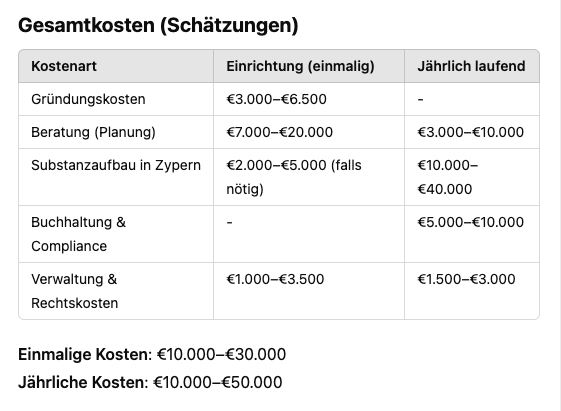
The costs for creation as well as for ongoing maintenance can vary depending on complexity. Below is a simplified overview of the costs, as well as an explanation for a basic setup.
- Official fees:
- Registration fees and permits in both countries: €1,000–€3,000.
Construction costs
One-off costs for setting up a fiscal unity model as follows.
a) Formation of the companies
- Austrian parent company:
- Establishment of a GmbH in Austria: €1,500–€3,500 (including notary fees, commercial register entry, fees).
- Existing company: no additional incorporation costs.
- Cypriot subsidiary:
- Incorporation of a Limited Company (Ltd) in Cyprus: €1,000–€3,000 (including attorney and administrative fees).
- Registration costs in Cyprus: ~€350 annual fee at the Cyprus Chamber of Commerce.
- Official fees:
- Registration fees and permits in both countries: €1,000–€3,000.
b) Consulting, Planning & Auditing
- Tax and legal advice:
- Tax advisors and lawyers (Austria and Cyprus): €5,000–€15,000 Depending on complexity.
- Erstellung und Prüfung des Organschaftsvertrags:
- In Österreich notwendig: €2.000–€5.000.
- Doppelbesteuerungsabkommen (DBA)-Prüfungen:
- Sicherstellen der korrekten Anwendung des DBA: €1,000–€3,000 (einmalig).
c) Substanzaufbau in Zypern
- Mietkosten für ein Büro (falls benötigt): €300–€1.500/Monat.
- Anstellung eines lokalen Geschäftsführers oder Mitarbeiters (optional, aber empfohlen): €20.000–€40.000/Jahr.
2. Laufende Kosten
Fortlaufende Kosten die wiederkehrend jedes Jahr für den Erhalt des Organschaftsmodells anfallen.
a) Buchhaltung und Steuererklärungen
- Austrian parent company:
- Laufende Buchhaltung und Steuerberatung: €2.000–€5.000/Jahr.
- Steuererklärung (inkl. Konsolidierung der Organschaft): €1.500–€3.500/Jahr.
- Cypriot subsidiary:
- Buchhaltung und lokale Steuerberatung: €1.500–€3.000/Jahr.
- Jahresabschluss und Einreichung bei der zypriotischen Steuerbehörde: €500–€1.500/Jahr.
b) Rechts- und Verwaltungsgebühren
- Cyprus:
- Jahresgebühr für die Handelsregistereintragung: €350.
- Kosten für Firmensekretär (Pflicht in Zypern): €800–€1.500/Jahr.
- Austria:
- Keine spezifischen Verwaltungsgebühren für die Organschaft, aber laufende Compliance-Kosten können durch Berater anfallen.
c) Substanzkosten in Zypern
- Betrieb eines Büros (falls erforderlich): €5.000–€20.000/Jahr (abhängig von der Größe und Lage).
- Lokale Geschäftsführer und Mitarbeiter: €20.000–€40.000/Jahr (falls substanzielle Präsenz erforderlich).
3. Zusätzliches
Weitere Kosten die Anfallen bzw. Anfallen können.
- Doppelbesteuerungsabkommen (DBA)-Prüfungen:
- Sicherstellen der korrekten Anwendung des DBA: €1,000–€3,000 (einmalig).
- Betriebsprüfungen (falls erforderlich):
- Steueranwälte oder Experten für Streitfälle: €5,000–€15,000.
Summary
Die Errichtung eines Organschaftsmodells zwischen Österreich und Zypern ermöglicht steuerliche Vorteile, insbesondere durch Verlustverrechnung und die Nutzung der niedrigen Steuerlast in Zypern. Dafür muss die österreichische Muttergesellschaft mindestens 50 % an der zypriotischen Tochtergesellschaft halten, eine wirtschaftliche Integration nachweisen und einen Organschaftsvertrag abschließen.
Die Kosten umfassen einmalige Aufwendungen für Gründung, Beratung und Substanzaufbau (ca. €10.000–€30.000) sowie jährliche Betriebskosten für Buchhaltung, Compliance und Substanz in Zypern (ca. €10.000–€50.000). Eine sorgfältige Planung, Einhaltung internationaler Regeln und fortlaufende Überwachung sind essenziell, um rechtliche und steuerliche Risiken zu vermeiden.