Skip to content

Malta is a popular tax haven in Europe and is attracting not only tourists, but also a growing number of expats. In addition to the fine weather, attractive tax benefits also draw many entrepreneurs and investors to Malta.
But how do you move to Malta, what requirements do you have to meet, and who is moving abroad actually worth it for? All these questions are answered in this comprehensive guide on moving to Malta.
Advantages
Malta offers a variety of advantages as an emigration destination. Below is an overview of the biggest benefits the island nation has to offer.
Climate
Malta offers a pleasant, Mediterranean climate with plenty of sunshine. It is never cold in winter, and already comfortably warm in autumn and spring. Anyone who dislikes gray weather and long winters will feel very much at home in Malta. Only the summer months of July and August can get very hot.
Location
The island is very well located and the airport near Valletta offers daily flights to the largest cities in Europe. Flight times within Europe are usually only around 2 to 3 hours, making it very well connected. International airlines such as Emirates and Qatar also fly to Malta.
Taxes
One of the biggest advantages is of course the taxes, because unlike many other EU countries, Malta is a true tax haven. Through the so-called Non-Dom regime, it is possible for expats to move to Malta and pay no taxes on foreign income, provided it is not transferred to an account in Malta.
Local companies pay a corporate income tax rate of 35 %, but this rate can be reduced to 6/7 if dividends are distributed to shareholders. As a result, business owners of local companies typically end up with a tax burden of only 5 %.
Language
Malta is a former British colony, so English, alongside Maltese, is an official language. Consequently, one does not have to learn a new foreign language, which significantly facilitates communication in daily life and with the authorities.
Disadvantages
No country is perfect, and Malta is no exception. Below is an overview of the biggest potential disadvantages of emigrating to Malta.
Prices
Malta is definitely not an inexpensive place, especially if you want to live in Valletta or the surrounding areas. These locations are very popular, and price tags per square meter exceeding €10,000 are not uncommon. Those who want to live more affordably have to move a bit further inland.
Food and other imported goods are relatively expensive.
Lack of variety
As an island, Malta itself offers relatively little variety. Valletta as a city is not particularly large, and in general, most places on the island are fishing villages. Anyone who likes a big-city vibe will not find it in Malta. Likewise, there are no mountains or other natural diversity on Malta.
On the other hand, the sea is beautiful, and anyone who likes water sports will get their money's worth.
Especially in winter, it gets very quiet in Malta, and you have to like that.
Prerequisites
Since Malta is in the EU, EU citizens at least have an easier time emigrating due to the freedom of establishment. You simply have to provide a job, self-employment, or proof of minor assets. For non-EU citizens, the requirements are significantly higher.
EU citizen
EU citizens only need to be able to prove employment. This can be done either through their own company, for example by founding a Malta Ltd, or through an employment relationship with a company in Malta.
Alternatively, you can provide proof of assets instead of income. This should amount to €14,000.
Non-EU citizen
The requirements for this are much stricter and the fees are also significantly higher. It is not without reason that Malta is an international hotspot for millionaires, because to meet the requirements as a non-EU citizen, you definitely need to be one. Below are several ways to get the residence permit.
Malta Permanent Residency Programme
- Proof of assets Anyone who can prove a total net worth of at least €500,000 and €150,000 in liquid assets fulfills the first important criterion.
- Accommodation Either a property with an annual rent of €14,000 must be rented, or a property worth €375,000 must be purchased.
- official fees Around €100,000 in non-refundable government fees are to be paid. €60,000 of this are administrative fees, €37,000 as a regulatory levy, and €2,000 are intended for a donation to a charitable organization.
Alternatively, there is also the Nomad Residence Permit with the following criteria that must be met.
- Proof of income Proof of an annual income of over €42,000.
- Employment contract / Service contract An existing employment or service contract with a foreign company must exist and be demonstrable.
- Minimum stay The duration of stay in Malta must be at least 5 months per year.
Process – How do I move to Malta? (EU citizens)
Below are the most important steps for a successful and legally secure emigration to Malta.
Clarify prerequisites
The first and one of the most important steps is clarifying the requirements. Because only when these are met should you think about the further steps of emigration. Especially for non-EU citizens, these are extremely selective and emigration [is...].
De-registration in home country
A very important step is deregistering in your home country. As a rule, several official institutions must be notified. These include, among others:
- Registry office
- Tax office
- (Statutory) Health Insurance
In addition, the emigration must actually take place and be verifiable. This means that the emigration should be traceable in writing (e.g., flight tickets) and existing living arrangements (rental agreement, etc.) must actually be given up.
Entry
As an EU citizen, there is nothing to consider upon entry, as no entry visa is required. However, non-EU citizens require a Schengen visa, which must be presented.
Lease or purchase agreement
Next, you need accommodation. This can either be bought or, as is usually the case, rented. This accommodation, along with the contract, is registered online (Malta Housing Authority) and is crucial for the residence permit application.
Employment contract, company or proof of capital
Subsequently, it is necessary to fulfill the legal prerequisite, which is an active employment relationship, your own company, or sufficient proof of capital.
Online application for the card
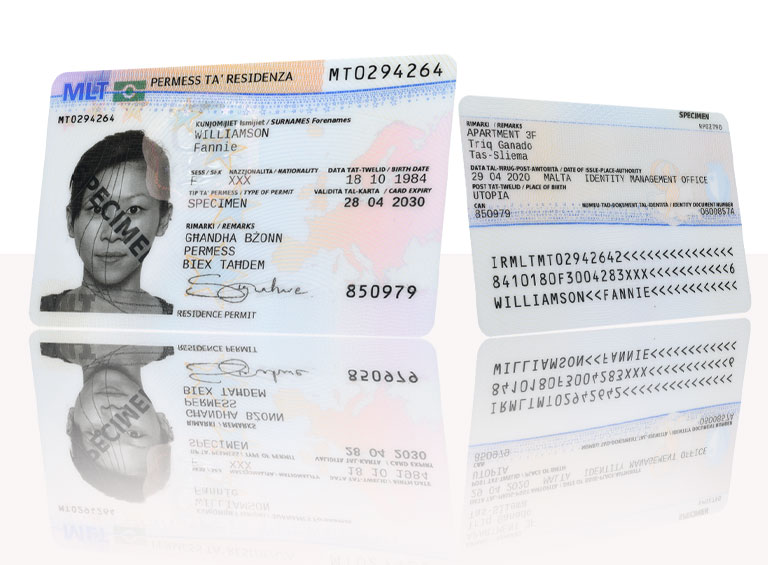
Provided you meet the criteria, you must apply for the residence permit within 3 months of arrival. This is done at one of the many official authorities in Malta or directly online at: https://expatriates.identita.gov.mt
Form A For Employees & Entrepreneurs
Form J: For proof of capital application
Form M: For students
Biometrics
Subsequently, you will receive an appointment electronically within a few days for the biometrics, meaning the taking of fingerprints. These biometric data along with your signature are stored on the card. The appointment takes place in one of the official facilities in Msida, Malta, Gozo, or Victoria.
All previous documents must also be printed out and brought to the appointment.
Issuance of the card
Typically, the card is produced within 30 days and you receive a pickup notice with which you can collect the card at the facility.
Costs
The cost of emigrating to Malta varies greatly depending on whether or not one benefits from simplified immigration as an EU citizen. Non-EU citizens must expect administrative costs of around €100,000, whereas EU citizens generally do not have to bear any costs for the issuance of the residence card.
Summary
Malta is an interesting emigration option primarily from a tax perspective. This is mainly due to the non-domicile rule, as foreign income remains tax-free provided it is not remitted to Malta. Consequently, Malta is among the most tax-favorable countries in the EU. Emigration is particularly easy for EU citizens, as they only need to provide proof of employment, a business, or modest financial assets. Non-EU citizens, however, face increased requirements associated with costs exceeding €100,000.